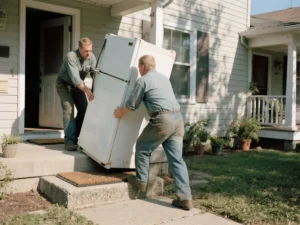
Nine years in the same home in Mirdif, and the shipping allowance covers about a third of what is in the house. The rest — two sofas, a dining set, a spare fridge, three wardrobes, a storeroom of boxes and a bedroom that became a dumping ground — has to be gone before the handover inspection.
That gap between what you are taking and what is still standing in the rooms is what a house clearance closes. It is not cleaning, and it is not a removal company moving your belongings to a new address. A house clearance Dubai job is the work of deciding what leaves, sorting it, and getting it physically out of the property before a deadline.
What Is a House Clearance?
A house clearance is the organised removal of unwanted contents from a home so the property can be handed back, sold, relet, renovated or simply used properly again. It applies to any residential property — an apartment, a townhouse, a compound home or a large detached villa — and covers furniture, appliances, electronics, soft furnishings, storage areas and the accumulated items that never made it into a decision.
Two things it is not:
- Not cleaning. Cleaners deal with dust, grease, glass, floors and bathrooms. A clearance crew deals with weight, volume and access.
- Not moving. Movers transport what you are keeping. A clearance takes away what you are not.
Most households need both, in sequence: clear first, clean after, with the move running alongside.
Full Clearance or Part Clearance?
Deciding this early changes everything about how the job is planned.
- Full house clearance — the property is emptied completely, usually before handover, sale or a departure from the UAE. Every room, plus storage, balcony and outdoor areas.
- Part clearance — specific rooms or categories go, and the rest stays. Common when a family is downsizing, refurnishing, or reclaiming a spare room.
- Single-item or small-load collection — one sofa, one fridge, one bedroom set. This is general junk removal rather than a clearance.
When People Book a House Clearance in Dubai
- Leaving the UAE — shipping a container and letting go of the rest
- End of tenancy — the property must be handed back empty
- Downsizing — a family home becomes a smaller apartment or townhouse
- Renovation — rooms are emptied before contractors start
- Selling a property — empty rooms photograph and show better
- Landlord turnaround — belongings left behind after a tenant moves out
- Clearing a home after a bereavement — a slower, more careful version of the same job
- Reclaiming a room — a storeroom, spare bedroom or maid’s room that filled up over the years
What Gets Removed During a House Clearance
Furniture
- Sofas, armchairs and majlis seating
- Beds, bed frames and mattresses
- Wardrobes, chests of drawers and dressing tables
- Dining tables, chairs and sideboards
- Children’s furniture, cots and bunk beds
Bulk is the part people misjudge. A wardrobe built inside a bedroom often has to come apart before it can leave it, and a corner sofa rarely exits the way it arrived. Where the load is mostly large pieces, it helps to understand how big furniture is taken out of a property, and how sofas in particular are handled, before you fix a date.
Appliances and Electronics
- Fridges, freezers, washing machines and dryers
- Televisions, monitors, laptops and desktop computers
- Routers, printers, games consoles and audio equipment
- Cables, chargers and small devices
Electrical items belong in their own pile rather than mixed through the furniture. Large white goods need disconnecting and draining before they move, which is covered under appliance collection, and smaller devices follow a different route again — worth reading on how unwanted electronics are dealt with if you have a drawer full of them.
Soft Furnishings and General Household Items
- Rugs, curtains, blinds and cushions
- Kitchenware, crockery, small appliances and pantry contents
- Toys, books, sports gear and luggage
- Boxes, bags and storage crates from cupboards and storerooms
Mattresses are worth flagging when you book, since they are bulky, hard to carry down stairs and usually collected as their own item.
What Usually Cannot Go With the Rest
Paint, solvents, fuel, gas cylinders, pool chemicals, car batteries and similar materials sit outside ordinary household collection. So do items that are not yours to dispose of. Raise anything in this category when you book rather than adding it to a pile on the day.
Sorting a House Before the Crew Arrives
Clearance work goes wrong at the sorting stage far more often than at the lifting stage. A four-pile method keeps it manageable:
- Keeping — going with you, or into shipping
- Selling or passing on — resale groups, friends, colleagues
- Donating — usable items a receiving organisation will actually accept
- Removing — collected during the clearance
Work room by room, not category by category — progress stays visible and rooms get finished. Physically label the first three groups, because anything unmarked in an emptying house starts to look like it is going. Leave the storeroom, balcony and any outdoor storage until last only if you have already scheduled time for them; they are almost always fuller than remembered.
Clearing a Home After a Bereavement
This is the same practical job carried out under difficult circumstances, and it should not be rushed to fit a crew’s schedule.
- Confirm you have the authority to dispose of the contents before anything is booked — that is a matter for the family and, where relevant, the estate’s legal representative, not something a removal crew can determine
- Set aside documents, photographs, jewellery and anything with personal significance in a locked or separate room first
- Check inside furniture — envelopes, papers and small valuables are routinely found in drawers, wardrobes and books
- Split the work across more than one visit if the family needs time
- Use a secure document-destruction service for financial or identity paperwork rather than putting it in a general load
A crew that will slow down, work room by room and stop when asked matters more here than one that can finish in a morning.
End-of-Tenancy House Clearance
Handover deadlines cause most of the pressure in this work. Tenancy agreements differ, so read your own rather than following what a neighbour did.
- Book collection several days before handover, not the morning of it
- Clear before the cleaners come — cleaning around furniture means cleaning twice
- Keep landlord property separate and marked: original fittings, remotes, keys, manuals, spare tiles
- Photograph rooms once empty, before cleaning, for your own records
- Leave a buffer for the second load nobody plans for
Landlords and Belongings Left Behind
Owners and property managers often need a home emptied quickly between tenants. The practical work is identical, but the first step is different: confirm you are entitled to dispose of what remains under your agreement with the outgoing tenant. That is a question for you and your legal advisor, not for the clearance provider. Once it is settled, the property is cleared the same way as any other.
The House Clearance Process
Procedures vary between providers, but a typical job runs in this order.
- Walk the property room by room and agree what is going
- Set aside everything staying — shipped items, sold items, landlord property
- Separate appliances, electronics and anything needing different handling
- Check access: lift, stairs, corridor width, parking, loading point
- Agree a date and an arrival window
- Clear pathways and stage smaller items in one place
- Dismantle large furniture where it cannot leave a room assembled
- Carry items out and load them
- Transport everything away from the property
- Route items onward according to condition and type
Larger homes are often split across two visits. That is normal planning rather than a failure of it.
Preparing the Property
- Write a rough inventory by room, including storage and outdoor areas
- Label or tape off everything that is staying
- Empty drawers, wardrobes and cabinets beforehand
- Check pockets, books, boxes and furniture cavities for documents and valuables
- Back up what you need from computers, phones and drives
- Sign out of accounts on devices you are letting go
- Defrost and drain fridges and washing machines a day ahead
- Confirm lift booking, gate access or visitor registration if your building or community requires it
Access rules differ between buildings and communities in Dubai, so check what applies at your own address rather than assuming a standard procedure exists.
Access: Apartments, Townhouses and Villas
The property type decides most of the logistics.
- Apartments — service lift booking, loading bay slots, corridor distance and building timing rules usually matter more than volume. The constraints are covered in more detail under apartment clearance.
- Townhouses and compound homes — gate registration, narrow internal lanes and internal staircases are the usual limits.
- Villas — driveway access is generally easier, but the volume is higher and garages, gardens and maid’s rooms add to it. That mix is set out under villa clearance.
Homes in Downtown Dubai, Dubai Marina and JLT tend to be lift-and-loading-bay jobs; Mirdif, Al Barsha, The Springs and Arabian Ranches are more often gate-and-driveway jobs. Say which you have when you book.
Documents, Data and Valuables
Two categories deserve attention before anything leaves.
Paperwork. Tenancy contracts, bank statements, medical records and identity documents turn up in drawers and books during almost every clearance. Pull them out first, and use a secure document-destruction service for sensitive records instead of adding them to a general load.
Devices. Laptops, desktops, phones, tablets, external drives, routers and even televisions signed into accounts hold information. Back up what you need, sign out of email, cloud storage, streaming and banking apps, remove the device from anything that tracks or locks it, and take out memory cards. A factory reset makes casual recovery harder but is not proof that data is gone — for genuinely sensitive drives, keep them out of the clearance or use a specialist data-destruction service. Do not assume a provider handles data securely unless you have asked and confirmed it.
What Happens to Items After Collection?
- Reuse, where furniture or appliances are still serviceable
- Donation, where an item is suitable and a receiving organisation will accept it
- Refurbishment or repair before reuse
- Recycling and material recovery — metal, wood, plastic, cardboard, textiles
- Disposal through appropriate channels where nothing else applies
The route depends on condition, materials, quantity, the processing options available at the time and the practices of the provider. A worn mattress and a two-year-old dining set do not end the same way. Treat any promise that an entire house will be recycled or donated with caution, and ask instead how a load is sorted.
What Affects the Size of a House Clearance
- Number of bedrooms and total floor area
- Volume of contents rather than the count of individual items
- Proportion of heavy furniture and white goods
- Floor level, lift availability and stair carries
- Whether storage, balcony, garage and outdoor areas are included
- Dismantling needed for wardrobes, beds or fixed units
- Items needing separate handling
- Timing — a fixed handover date, an evening slot, a weekend request
An accurate description at first contact produces a workable plan. A vague one produces a crew finding a full storeroom on the day.
Common House Clearance Mistakes
- Leaving it to the last week — sorting always takes longer than lifting
- Not marking what stays — the most common cause of the wrong item leaving
- Skipping the storeroom — usually the fullest space and the last one opened
- Letting devices go with data on them — old laptops and drives are easy to overlook
- Not booking the service lift — an unbooked lift can cost the entire slot
- Underestimating bulky pieces — wardrobes and corner sofas need dismantling time
- Mixing hazardous materials into the load — flag paint, chemicals and cylinders separately
- Cleaning before clearing — it means paying for the same room twice
Choosing a House Clearance Service in Dubai
Before committing to a house clearance Dubai provider, it is worth checking each of these:
- Experience with whole-property clearances, not only single pickups
- Enough people to move heavy furniture and white goods safely
- How appliances and electronics are separated from general items
- Whether dismantling is included or arranged separately
- Familiarity with service lifts, loading bays, gated communities and building rules
- Ability to work to a fixed handover or shipping date
- A straightforward explanation of what happens to items after collection
- A considerate approach where the clearance is a sensitive one
House Clearance vs House Cleaning
| House Clearance | House Cleaning |
|---|---|
| Removes contents and empties the property | Removes dirt, dust and stains from surfaces |
| Deals with furniture, appliances and volume | Deals with floors, glass, kitchens and bathrooms |
| Needs vehicles, labour and access planning | Needs equipment, products and time |
| Comes first | Comes after the rooms are empty |
A clearance does not include cleaning unless that is arranged separately.
House Clearance, Junk Removal and Removals
- House clearance — emptying a home, wholly or partly, usually against a deadline, with sorting and planning built in
- Junk removal — collecting a defined set of unwanted items, with no whole-property scope
- Bulky item collection — a single heavy piece, such as a wardrobe or a fridge, handled on its own
- Removal companies — transporting the belongings you are keeping to a new address
If you can list what needs to go on your fingers, it is a collection. If you are walking rooms deciding what stays, it is a clearance.
Frequently Asked Questions
What does a house clearance include?
It usually covers removing unwanted furniture, appliances, electronics, soft furnishings and general household items from the rooms you nominate, then transporting them away. What is included depends on what you agree beforehand, so confirm the room list — storerooms, balconies and outdoor areas especially — rather than assuming the whole property is covered.
Can part of a house be cleared instead of all of it?
Yes. Part clearances are common when a household is downsizing, refurnishing or reclaiming a single room. Be specific about which rooms and which items are in scope, and mark everything that is staying, since a partial job carries more risk of the wrong item being taken.
How long does a house clearance take?
It depends on the number of bedrooms, the volume of contents, the floor level and how close a vehicle can load. A sorted two-bedroom apartment often finishes in a single visit. A four-bedroom family home with a full storeroom is more realistically planned across two, especially if furniture needs dismantling.
What happens to furniture and appliances that still work?
Usable items may be reused, refurbished or offered for donation where a receiving organisation accepts them. Damaged or unsafe items generally go for material recovery or appropriate disposal. The outcome depends on condition, item type, quantity and the options available at the time, so no provider can promise a specific result for every piece.
Is a house clearance the same as a villa or apartment clearance?
They describe the same work on different property types. House clearance is the general term; villa clearance deals with the extra volume of garages, gardens and maid’s rooms, and apartment clearance is shaped by lifts, corridors and building access rules. The sorting, preparation and handling are broadly the same.
Arrange Your House Clearance
Handing back a home, leaving the country, downsizing or emptying a property for someone else — tell us the property type, the number of bedrooms, which rooms are involved and the date you are working toward. Contact our team to talk it through and schedule a collection that fits your handover.