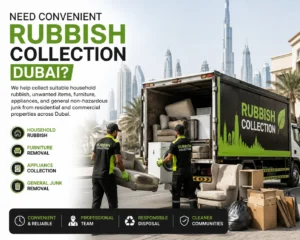
Every business generates junk, and it rarely stops. Packaging piles up in a stockroom, an office swaps out old furniture, a restaurant clears its back-of-house, a salon strips out old fittings — and unlike a one-off house clear-out, it keeps coming. Commercial junk collection in Dubai is built for exactly that: scheduled or on-call collection that keeps a business clear of accumulated junk without the clutter ever taking over the premises.
This guide looks at commercial junk collection as an ongoing service — how scheduled pickups work, which sectors rely on them, and how the service fits alongside one-off commercial junk removal for larger clear-outs.
What commercial junk collection covers
Commercial junk collection deals with the mixed, non-hazardous junk a business produces as it operates. Rather than a single clear-out, the focus is on regular or repeat collection so waste never has a chance to build up. A typical service handles:
- Packaging and cardboard — boxes, wrapping, pallet wrap and delivery materials that stack up fast
- Old furniture and fittings — desks, chairs, shelving, counters and display units being replaced
- General operational junk — broken equipment, obsolete stock, signage and everyday clutter
- Electronics and small equipment — retired devices and office electronics as e-waste
- Mixed loads — the combination of the above that most businesses generate over a week or a month
The point of difference is rhythm: the collection is arranged around how often the business produces junk, not around a single visit.
Why businesses choose scheduled collection
A one-off pickup solves a build-up that has already happened. A scheduled collection stops the build-up from happening in the first place, and that suits the way most businesses actually run:
- Consistent output — premises that generate junk steadily, week in and week out
- Presentation matters — customer-facing spaces that cannot have junk stacked in view
- Limited storage — units with no room to let waste accumulate between clear-outs
- Predictable cost and planning — a known collection rhythm rather than scrambling for an ad-hoc pickup
- Less staff time lost — employees not tied up moving or storing junk
Collection can be set up weekly, fortnightly, monthly, or simply on-call for businesses whose output is less regular. The schedule is matched to the premises rather than forced into a fixed template.
Commercial junk collection by sector
Different businesses produce different junk, and a good collection service adapts to each.
Offices and corporate spaces
Offices generate a steady flow of packaging, retired IT equipment, old furniture and paper-era clutter, particularly during reorganisations. Ongoing collection keeps floors and storerooms clear, and pairs naturally with routine office waste collection.
Retail and shopping units
Shops turn over stock, packaging and display materials constantly, and seasonal changes bring spikes. Regular collection keeps stockrooms usable and shop floors presentable.
Restaurants, cafes and hospitality
Food-service premises produce heavy operational junk — packaging, worn equipment and back-of-house clutter. Frequent collection is essential to keep these spaces clear and workable.
Warehouses and industrial units
Warehouses accumulate pallets, packaging, broken racking and obsolete stock at volume. Scheduled collection prevents it from swallowing floor space, and larger jobs can tie into a warehouse cleanout.
Salons, clinics and service businesses
Smaller commercial premises still produce a steady stream of packaging, old fittings and general junk, and being customer-facing, they benefit from keeping it out of sight with regular pickups.
How commercial junk collection works
The service is designed to run in the background of a business without disrupting it.
1. Assess the need
Tell us what the business produces — the types of junk, roughly how much, and how often. This sets the right collection frequency and vehicle.
2. Agree a schedule
Choose a rhythm that fits — weekly, fortnightly, monthly or on-call — and a collection window that works around opening hours and quiet periods.
3. Regular collection
The team arrives on the agreed days, collects the junk from a designated point or from within the premises, loads it, and leaves the area clear. Staff are not tied up moving anything heavy.
4. Sorting and disposal
Each load is sorted so recyclable material — cardboard, paper, plastics and metal — is separated where possible, and only genuine waste is sent for disposal.
How it differs from related services
Commercial junk collection overlaps with several services, so it helps to see where it sits. The table below sets out the differences.
| Service | Main focus | Best for |
|---|---|---|
| Commercial junk collection | Scheduled or on-call collection of ongoing business junk | Keeping a business clear on a regular rhythm |
| Commercial junk removal | One-off removal of accumulated commercial junk | A specific clear-out, refit or shutdown |
| Office waste collection | Routine everyday office waste | Day-to-day office bin and waste service |
| Bulk waste removal | Large volumes of heavy, mixed material | High-volume one-off loads |
| Construction waste removal | Building and fit-out debris | Renovations and construction sites |
In practice these combine. A business might run a regular collection for its everyday junk and call in one-off commercial junk removal for a bigger clear-out, or a construction waste removal service when it fits out a new space.
Handling different waste streams responsibly
Commercial junk is rarely a single material. A typical load mixes cardboard, plastics, metal, timber and general waste, and treating it as one stream sends far too much to landfill. Sorting at the collection stage means recyclables are recovered and only genuine waste is discarded — which matters more as Dubai continues to push businesses toward higher recycling and diversion rates.
Some categories sit outside a standard collection and need separate handling. Hazardous materials — chemicals, batteries, certain electricals and pressurised containers — must not go in with general commercial junk, and heavy construction debris is better suited to a dedicated service. Flagging anything unusual when the schedule is set up means it is handled correctly rather than left behind. This is general good practice; specific trade-waste requirements should be confirmed with the relevant authority for your business type.
Keeping premises clear and compliant-minded
Junk left accumulating on commercial premises is more than untidy. It can block walkways and fire exits, create hygiene and pest issues, and leave a poor impression on customers and visitors — and in Dubai’s climate, waste left standing degrades quickly. A regular collection keeps common areas, stockrooms and yards clear, which supports both a safe working environment and a presentable business.
Because the collection runs to a schedule, the premises stay clear continuously rather than lurching between clear-outs. For businesses that want everything handled predictably, that reliability is often the main reason to move from ad-hoc pickups to a standing collection arrangement.
What happens to the collected junk
A commercial collection is not simply hauled to landfill. A good share of business junk can be recovered:
- Recyclables — cardboard, paper, plastics and metal are separated where possible
- Reusable items — furniture and equipment in good condition may be suitable for donation or resale where appropriate
- Metal — fittings, frames and equipment bodies are directed to scrap and metal recycling
- Genuine waste — only unusable material is sent for disposal
Sorting this way keeps a meaningful share of commercial junk out of general waste.
Setting up a collection that fits your business
The most useful commercial collection is one shaped around the actual premises. A few things help get it right:
- Note the main types of junk the business produces
- Estimate how much builds up over a typical week or month
- Identify a collection point that is easy to reach without disrupting operations
- Flag any items that need separate handling, such as electronics or anything hazardous
- Consider quieter periods when a collection will least affect trade
With those in place, the schedule can be set to match the business rather than the other way around.
Scaling collection as a business grows
Junk output rarely stays flat. A business that opens a second location, expands its team, adds stock lines or moves into a bigger unit will produce more waste, and a collection arrangement should be able to move with it. That is one of the advantages of a scheduled service over ad-hoc pickups: the rhythm can be dialled up or down as the business changes, rather than starting from scratch each time.
A quiet season might call for less frequent collection, a busy trading period or a fit-out for more. Reviewing the schedule periodically keeps it matched to actual output, so a business is never paying for collections it does not need or scrambling when junk suddenly builds up faster than expected.
Reducing a business’s waste footprint
For many businesses in Dubai, how waste is handled is increasingly part of how they present themselves — to customers, to landlords and to partners. A collection service that sorts and recycles rather than sending everything to landfill supports that, and gives the business a clearer picture of what it is throwing away.
Seeing the volume and type of junk collected over time can also prompt practical changes: cutting excess packaging, reusing materials, or separating recyclables at source so more is recovered. Over months, a well-run collection does more than keep the premises clear — it helps a business waste less in the first place.
Why use a dedicated collection service
Managing commercial junk in-house usually means staff moving and storing waste, unpredictable build-ups, and scrambling for a pickup when it gets out of hand. A dedicated collection service takes that off the business entirely: the junk is collected on a reliable rhythm, sorted responsibly, and the premises stay clear without anyone having to think about it. For a growing business, that predictability is worth as much as the removal itself.
When you want commercial junk handled on a schedule that suits your premises, contact our team to set up a collection. For a single large clear-out, a refit or a shutdown, our Dubai junk removal service handles the heavier one-off jobs.
Frequently asked questions
What is the difference between commercial junk collection and removal?
Collection is an ongoing, scheduled or on-call service that keeps a business clear of everyday junk. Removal is typically a one-off job for a specific clear-out, refit or shutdown. Many businesses use both.
How often can junk be collected?
As often as the business needs — weekly, fortnightly, monthly, or on-call. The frequency is matched to how much junk the premises produce, and can be adjusted as needs change.
Which types of business do you collect from?
Offices, retail units, restaurants and cafes, warehouses, salons, clinics and other commercial premises. The service is adapted to the junk each sector typically produces.
Can you collect outside our opening hours?
Collection windows can usually be arranged around opening hours and quieter periods so the pickup does not disrupt trade. Let us know your preferences when setting up the schedule.
What happens to the junk after collection?
Each load is sorted so recyclables such as cardboard, plastics and metal are recovered, reusable items may be passed on where appropriate, and only genuine waste is sent for disposal.
Do you handle hazardous or construction waste?
Standard commercial collection is for general, non-hazardous junk. Hazardous materials and heavy construction debris need separate, dedicated handling — flag these when setting up so they are managed correctly.
Can we start with a one-off collection and move to a schedule?
Yes. Many businesses begin with a single collection to clear a build-up, then set up a regular schedule once they see how much junk accumulates over time.