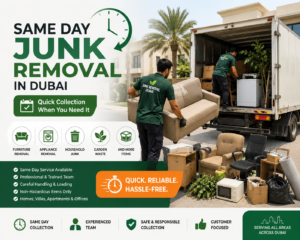
The new sofa is scheduled to arrive on Saturday, and the old one is still wedged in the living room, too big for the bin area and too heavy for two people to carry down three flights. A treadmill sits unused in a spare room because nobody can face lifting it. A wardrobe won’t fit back through the doorway it somehow came in through years ago. These aren’t a truckload of clutter. They are single, awkward, heavy things, and the whole problem is getting each one out of the property in one piece.
That’s what large item removal in Dubai is for: taking away individual oversized or heavy items, often just one or a few, that are difficult to move because of their size, weight, or the access around them. The challenge here isn’t quantity. It’s maneuvering something big and heavy through doorways, stairs, and lifts without damaging the item, the walls, or anyone’s back.
This guide explains what large item removal covers, why access is usually the hard part, and how homeowners, tenants, and businesses across Dubai can arrange it sensibly.
What Is Large Item Removal?
Large item removal is the collection of individual oversized or heavy items from a property. The defining feature is the item itself rather than the volume. You might have exactly one thing to move, a corner sofa, an American-style fridge, a piano, but it’s big enough or heavy enough that ordinary disposal simply doesn’t apply and it needs proper handling to get out safely.
It helps to keep a few ideas separate. Everyday waste is what a bin service handles. A large item is a single sizeable piece that needs planning to move. A bulk load is a large quantity of items cleared together. Large item removal sits at the single-piece end: the focus is on assessing one awkward item, working out how it comes apart and how it gets out, and moving it without damage.
Because it’s about the item and its route out, the same service can apply whether you have one heavy safe or a handful of oversized pieces spread around a home.
What Counts as a Large Item?
In Dubai homes and workplaces, the items people most often need help moving out include:
- Sofas and corner units, especially large or non-dismantling frames
- Wardrobes, cabinets, and large shelving
- Beds and mattresses, including king and super-king sizes
- Large appliances: fridges, freezers, washing machines, and ovens
- Dining tables and heavy desks
- Gym and exercise equipment such as treadmills and multi-gyms
- Pianos and other heavy speciality items
- Safes, large mirrors, and glass units
- Garden furniture, outdoor sofas, and large BBQs
Not every large item is handled the same way. Appliances and electronics are usually kept separate, and some pieces, like pianos or safes, need particular equipment and technique. What a service will take, and how it approaches each item, varies by provider, so it’s worth describing the item and its location before booking.
Common Reasons for Large Item Removal
Most large item jobs come from a straightforward change rather than a big clear-out. The usual reasons include replacing a sofa, bed, or appliance and needing the old one gone; upgrading furniture; clearing a single bulky item that’s no longer used; a broken appliance that has to be taken out; making space in a room; or moving home and dealing with the one or two pieces that won’t travel with you.
Sometimes the item is simply in the way, a treadmill in the spare room, an old wardrobe blocking a renovation, garden furniture that needs to go before new pieces arrive. The common thread is a single large object that’s too heavy or awkward to handle without help.
The Real Challenge: Access and Handling
With large item removal, the item is rarely the whole problem, getting it out is. A piece that fitted a room years ago may no longer clear the doorway now that a different door or flooring is in place. Tight corners, narrow hallways, staircases, and lift dimensions all decide whether something comes out whole or needs to be partly dismantled.
Handling matters just as much. Heavy items need the right number of people and proper lifting technique to avoid injury and to protect floors, walls, door frames, and the item itself. Measuring the item against the route out, doorways, turns, lift openings, is the single most useful thing you can do before the day, and a good service will think this through with you.
Large Item Removal from Apartments
Apartments are where access causes the most trouble. Moving a large item out of a flat means planning around corridors, the service lift, stairwells, parking, and the loading area before anyone lifts anything.
Buildings often have rules: bulky items may only travel in the service lift, moving may be limited to certain hours, and management usually wants advance notice. If an item won’t fit the lift, it has to go down the stairs, which changes the time and the number of people needed. Residents in Dubai Marina, JLT, Downtown Dubai, Business Bay, and JVC deal with this regularly, and confirming lift access and a loading spot ahead of time is what keeps a single-item job from turning into a long one. Our apartment clearance page covers building access in more depth.
Large Item Removal from Villas
Villas usually have easier ground-floor access through a driveway, but the difficulty moves to stairs between floors and the weight of items in larger homes. A heavy wardrobe or a solid-wood bed from an upstairs bedroom still has to be brought down safely, and outdoor items, garden sofas, large planters, BBQs, add their own bulk. Family homes in Jumeirah, Al Barsha, Arabian Ranches, Dubai Hills Estate, and Mirdif are where these heavier single-item moves most often come up. If you’re clearing more than a single piece, our villa clearance service may fit better.
Furniture: Sofas, Beds, and Wardrobes
Furniture makes up most large item requests because it’s heavy and rarely comes apart neatly. Sofas, corner units, beds, mattresses, wardrobes, and large tables are the usual pieces. Some disassemble, which makes the route out easier; others have to be carried whole and turned carefully through doorways.
For these specific items we have focused pages that may suit better than a general request: furniture removal, sofa removal, mattress removal, and bed removal.
Appliances and Electronics
Large appliances are a common single-item job: fridges, freezers, washing machines, ovens, and dryers. Big electronics such as wall-mounted TVs also come up. These aren’t ordinary waste. They contain components and materials that mean they’re kept separate from general items and often follow a different recovery route.
Two practical points. Don’t try to dismantle appliances or electrical equipment yourself to make them lighter, as that can be unsafe. And clear any personal data from devices before they leave. For these items, see our appliance removal page and electronics disposal page.
Speciality Large Items
Some large items sit in a category of their own because of their weight or design. Pianos, safes, large gym machines, and oversized glass or mirrors need particular equipment and technique, and moving them without the right approach risks damage or injury. If you have an item like this, mention it clearly when you arrange the collection so the team can bring the right people and equipment rather than being surprised on the day.
How Large Item Removal Works
The exact steps vary by provider, but moving a large item usually follows a clear shape:
- Identify the item and its dimensions.
- Check the route out: doorways, corners, stairs, and lift openings.
- Decide whether it needs to be partly dismantled.
- Protect floors, walls, and door frames where needed.
- Move the item carefully along the planned route.
- Carry or wheel it to the vehicle.
- Load it safely and secure it.
- Transport it away.
- Route it to an appropriate destination based on type and condition.
The planning at the start, matching the item to the route out, is what separates a smooth large item removal from a stuck one.
How to Prepare for a Large Item Collection
A little preparation makes the day quicker and safer:
- Measure the item, and measure the doorways and turns it has to pass through.
- Note the floor level and whether there’s lift access.
- Clear the route: move smaller obstacles, rugs, and anything fragile.
- Book the service lift and confirm access times if you’re in a building.
- Confirm parking and a loading spot near the exit.
- Flag any speciality item, such as a piano or safe, in advance.
- Remove personal data from any appliance or device.
Don’t take apart appliances or electrical items yourself, and don’t attempt to move a heavy piece alone, that’s exactly what the removal is for.
What Happens After the Item Is Removed?
A large item doesn’t always end up in the same place. Depending on the piece and its condition, it may be reused, donated where it’s genuinely suitable, recycled, recovered for materials, or disposed of appropriately.
Which route applies depends on the item type, its condition, the materials, and the processing options available. It’s worth being realistic: a well-kept sofa and a broken, damaged appliance don’t have the same outcome, and no honest service can promise that every item is donated or recycled. Sensible handling means matching each item to the best available route rather than making blanket claims.
Items That May Need Special Handling
Some large items or their contents shouldn’t be treated as ordinary waste. Appliances with refrigerant, large glass units, and anything containing chemicals, batteries, or pressurised parts may need particular handling. The principle is simple: if you’re unsure whether an item is straightforward, say so.
Tell the service about any unusual, hazardous, or speciality item before collection so it can be handled correctly. This guide doesn’t give instructions for dealing with dangerous materials, because those should be disclosed and handled through the proper channel rather than managed on site.
Large Item Removal Cost Factors
There’s no single price for moving a large item, because the effort depends on the piece and its setting. Rather than quote figures, it helps to understand what drives it. Cost and effort generally scale with:
| Factor | Why it matters |
|---|---|
| Size and weight of the item | Heavier, bulkier pieces need more people and care |
| Floor level | Upper floors add time, especially without a lift |
| Stairs vs. lift access | Carrying down stairs is slower and needs more hands |
| Dismantling required | Some items must be taken apart to get them out |
| Route difficulty | Tight doorways, corners, and hallways add effort |
| Distance to the vehicle | How far the item is carried to load it |
| Speciality handling | Pianos, safes, and glass need particular equipment |
| Number of items | One piece differs from several oversized items |
The honest position is that it depends on the item and the access around it. The best way to understand yours is to describe the item, its size, and where it sits. We won’t promise a lowest price or make guarantees we can’t stand behind; what we can do is assess the actual job.
Common Mistakes to Avoid
- Not measuring the item against the doorways and route out.
- Assuming a heavy piece can be moved by one or two people.
- Forgetting to book the service lift or confirm building access.
- Not protecting floors and walls, then damaging them mid-move.
- Leaving a speciality item, like a piano, unmentioned until the day.
- Trying to dismantle an appliance to make it lighter.
- Leaving personal data on an old appliance or device.
- Not clearing the route before the team arrives.
Most of these come down to one habit: measure and plan the item’s path out before anyone starts lifting.
Large Item Removal vs. Bulk Waste Removal
These overlap but differ in scale. Large item removal is about individual oversized or heavy pieces, often just one, where the challenge is maneuvering and access. Bulk waste removal is about large quantities cleared together, where the challenge is volume and vehicle size. If you’re clearing a whole space rather than a single piece, our bulk waste removal page is the closer fit.
Large Item Removal vs. Furniture Removal
Furniture removal focuses specifically on furniture, sofas, beds, wardrobes, tables. Large item removal is broader: it also covers appliances, gym equipment, safes, pianos, and other oversized objects that aren’t furniture. If your item is a piece of furniture, a furniture removal service may be exactly what you need; if it’s a mixed set of large objects, large item removal covers them all.
Large Item Removal vs. Junk Removal
Junk removal is a broad term for clearing unwanted items of any size. Large item removal is the part focused on the big, heavy, awkward pieces that need careful handling to move. If you have a range of items large and small, a general junk removal service may suit; if the whole job is one or two oversized pieces, large item removal is the right frame.
How to Choose a Large Item Removal Service
When comparing options in Dubai, a short checklist helps:
- Does it handle the type of item you have, including speciality pieces?
- Can it manage heavy items safely, with enough people?
- Is it comfortable with apartment lifts, stairs, and building rules?
- Will it dismantle and protect the property where needed?
- Is scheduling flexible around your delivery or move dates?
- Does it route items to appropriate handling afterward?
- Is communication clear about what’s involved and how it’s priced?
Be cautious of claims that can’t be backed up, invented certifications, exact recycling percentages, or guarantees that sound too clean. Straight answers about handling, access, and equipment are a better sign than a long list of promises.
Frequently Asked Questions
What does large item removal in Dubai cover?
It covers taking away individual oversized or heavy items, from sofas, wardrobes, and beds to fridges, gym equipment, and speciality pieces. What a specific service accepts can vary, so describe the item and where it sits when you book.
Can you remove just one large item?
Yes. Large item removal is well suited to a single piece, such as one old sofa or a broken appliance. The service is built around moving one awkward item out safely, not only whole-space clearances.
Can a large item be taken from an upper-floor apartment?
Yes. The main consideration is access: the service lift, stairs, corridors, and building rules. Confirming lift availability and any required notice with building management ahead of time keeps the collection smooth.
Do you dismantle items that won’t fit through the door?
Where an item can be safely taken apart to get it out, that’s often part of the job. Mention any piece you think may not clear the doorways so the right approach and tools are arranged in advance.
Can you handle heavy speciality items like pianos or safes?
These need particular equipment and technique, so flag them clearly when booking. That lets the right people and equipment be arranged rather than the team being surprised on the day.
Can old appliances be removed as large items?
Yes, appliances such as fridges and washing machines are common large item jobs. They’re kept separate from ordinary waste because of the components they contain, and you shouldn’t try to dismantle them yourself.
What happens to a large item after it’s removed?
Depending on the item and its condition, it may be reused, donated where suitable, recycled, recovered for materials, or disposed of appropriately. The route depends on the item type, condition, and available options.
How do I prepare for a large item collection?
Measure the item and the route out, clear obstacles, note the floor level and lift access, and flag any speciality piece. A little preparation makes the move faster and safer.
Arrange Your Large Item Removal in Dubai
Whether it’s a single heavy sofa, an old appliance, or a speciality piece that needs careful handling, the first step is to describe the item, its size, and where it sits in the property. From there, the right people, equipment, and access can be planned around your item and your timeline.
To arrange large item removal anywhere in Dubai, contact our team and tell us what needs moving. We’ll take it from there.