A tenant in Dubai Marina finishes a weekend tidy-up and ends up with four bags of general waste, a broken drying rack, a worn office chair and a stack of flattened boxes in the hallway. None of it belongs in the building’s bin room, security wants it gone before Friday, and dragging a chair into a passenger lift is not a serious plan. That is usually when someone starts searching for a waste collection Dubai service.
This waste collection Dubai guide covers what the service involves, how it differs from waste removal, and the details that decide whether a pickup goes smoothly: volume, access, timing, preparation, and what happens to the material afterwards — for apartments, villas, offices, shops and clear-outs.
What Is Waste Collection?
Waste collection is the part of the job that happens at your property. A team arrives at an agreed address and time, gathers the waste you have set aside, loads it into a vehicle and transports it to a handling point where it can be sorted, recovered or disposed of. Gathering, loading and transportation sit at the centre of it. Everything else happens after the vehicle leaves.
It is not limited to bagged rubbish. Depending on the provider, a pickup can include bulky waste such as a mattress or wardrobe, cardboard from a shop delivery, green waste from a villa garden, or the general waste left behind when a tenant moves out. The same word also covers repeat arrangements, where waste is collected from an agreed point on a set pattern.
Waste Collection vs Waste Removal: What Is the Difference?
In everyday use the two terms describe the same outcome, and providers in Dubai often use them interchangeably. The difference is emphasis rather than a technical rule:
- Collection focuses on the pickup: where the waste is, when it will be gathered, how often, and from which point.
- Removal focuses on getting unwanted material out of a space: what needs to go, how much labour is involved, and how the space looks afterwards.
A simple test: if you are asking “when can someone pick this up?”, that is collection. If you are asking “can you clear this room out?”, you are closer to waste removal work. Many jobs are both. Describe what you physically have and let the provider confirm which service fits.
When Do People in Dubai Need Waste Collection?
Most requests come from ordinary situations rather than emergencies:
- Household waste building up faster than the building’s bins can take
- Decluttering that produces bags, boxes and a few awkward items
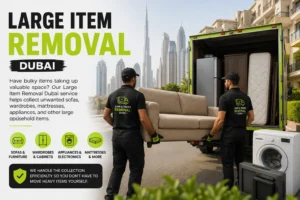
- Bulky waste such as a sofa, bed frame, wardrobe or mattress
- Move-outs with leftover belongings and packing material
- Home clear-outs before handover, or after a tenancy ends
- Office clear-outs with old desks, chairs and paper waste
- Shop clearances where fixtures and packaging accumulate
- Garden maintenance at a villa leaving cuttings and trimmings
- Furniture replacement, or premises prepared for a new tenant
Household Waste Collection in Dubai
Residential pickups make up the largest share of waste collection Dubai requests, coming from tenants, homeowners, landlords between tenancies and property managers handling several units. The property shapes the job more than the waste does.
Volume is the first thing to get right. A few bags and a chair is a different job from a spare room filled with boxes and a bed base. An honest description gets a suitable vehicle and enough crew on the first visit.
Access is the second. In an apartment building the practical questions are which lift can carry goods, whether management needs advance notice, where the vehicle can park, and whether quiet hours limit heavy lifting. Timing matters too, since traffic around areas such as Business Bay affects any realistic arrival window. Routine domestic volumes and bulky waste collection are often handled in one visit.
Commercial Waste Collection in Dubai
For businesses, waste collection Dubai planning is mostly about disruption rather than the waste itself. A pickup that blocks a loading bay at the wrong hour creates a bigger problem than the waste did.
Offices and Retail Units
Offices produce steady paper and packaging waste, then surges when a team expands or furniture is swapped out, and storerooms are where the surge collects. Service lifts, security passes and permitted working hours matter here, particularly in towers around JLT and Dubai Silicon Oasis, which is why office waste collection is often arranged outside core hours. Retail units generate cardboard almost daily plus fixtures during a refit, so collections must fit around deliveries and mall or community access rules.
Relocations and Larger Clear-Outs
Business moves and office clearance projects work better in stages: agree what leaves first, what stays until the last day, and which materials must be kept separate. Coverage varies by provider, so confirm your area is served before planning around a date.
What Types of Waste Can Be Collected?
Accepted materials vary between providers and are worth confirming rather than assuming. Commonly collected items include:
- General household waste, bagged and ready to load
- Bulky items such as mattresses, bed frames, wardrobes and sofas
- Furniture from homes and offices, including dismantled pieces
- Unwanted household appliances
- Cardboard, packaging and shipping material
- Office waste such as paper, files and small fittings
- Garden and green waste where accepted
- Mixed material from a property clear-out or house clearance
Waste That May Require Specialist Handling
Some materials are unsuitable for an ordinary collection and go through separate, regulated channels. Examples include chemicals and cleaning agents, paint and solvents, fuel, oil and gas cylinders, medical or clinical waste, anything described as hazardous or flammable, and certain categories of electronic waste and batteries.
Do not decant, mix or dispose of these yourself, and never hide them in a bag of general waste. Keep them separate and mention them when you arrange the pickup, so the provider can say whether they can handle the material or whether it needs a specialist route. For end-of-life devices, ask about electronics disposal before adding them to a general load. General guidance on waste management in the UAE is published on the UAE Government portal.
How Does Waste Collection Work?
Most waste collection Dubai providers follow broadly the same sequence:
- Walk through the property and identify what is going, including balconies, storerooms and the garage
- Estimate the amount by counting bags and bulky items
- Contact the provider with the address, property type and floor
- Explain access: lift or stairs, parking, gate width, loading bay, building rules
- Confirm accepted materials for anything you are unsure about
- Agree a date and a realistic arrival window
- The team arrives and confirms the scope with you
- Waste is gathered and loaded, with bulky items dismantled or wrapped where needed
- The load is transported away in the collection vehicle
- Suitable materials may be separated for reuse, recycling or recovery, and the rest disposed of appropriately
Can Waste Collection Be Arranged on the Same Day?
Same-day waste collection Dubai requests are sometimes possible, but it should never be treated as guaranteed. It depends on the location and whether a crew is already working nearby, the time of day the request is made, crew and vehicle availability, how full the schedule already is, the quantity and type of waste, and property access, including any building approval needed first.
A small load in a well-served area such as Al Barsha or JVC requested early in the morning has a better chance than a late-afternoon villa clear-out. If your deadline is fixed, book ahead.
Scheduled vs One-Time Waste Collection
One-Time Collection
A single pickup suits jobs with a clear end point: home clear-outs, end-of-tenancy cleanups, moving, furniture replacement, preparing a property for handover, or a backlog that has been building for months.
Scheduled Collection
A repeat arrangement suits properties and businesses producing suitable waste at a steady rate, such as a retail unit with daily packaging or a villa with ongoing garden maintenance. The value is predictability: an agreed collection point and pattern, with no need to arrange each pickup from scratch. Available patterns differ between providers, so agree yours directly rather than assuming a standard frequency exists.
What Affects Waste Collection Cost in Dubai?
Waste collection Dubai pricing is built from the job, because two pickups at the same address can involve very different work.
| Factor | Why it matters |
|---|---|
| Volume | Space used in the vehicle, and whether a second trip is needed |
| Waste type | Different materials need different handling and destinations |
| Number of items | Many small items can take longer to load than one large one |
| Weight | Dense material such as wet garden waste limits what a vehicle can carry |
| Labour and time | Crew size and how long the visit takes |
| Loading conditions | Dismantling, wrapping, and carrying distance to the vehicle |
| Property access | Stairs, lift availability, narrow corridors, parking, gate limits |
| Distance | Travel to the property and to the handling point |
| Timing | Short notice, evening work, restricted access windows |
| Specialist handling | Anything needing a separate route adds cost and coordination |
To compare providers fairly, give each the same description: item list, floor, lift or stairs, parking and preferred day. Costs based on vague descriptions tend to change on site.
How to Prepare Waste for Collection
Preparation is what makes a waste collection Dubai visit faster and cheaper:
- Separate anything that should not be collected and set it well away from the pile
- Keep chemicals, paint, fuel and batteries apart and clearly identified
- Count and describe the load honestly: bags, boxes and bulky items
- Flag heavy or oversized pieces in advance, such as a marble table top
- Bag loose waste and flatten cardboard to save loading time and space
- Clear the route to the door and move rugs or fragile items aside
- Check building rules and arrange any notice, permit or service lift booking
- Keep documents, keys, chargers and valuables separate
What Happens After Waste Is Collected?
Once the vehicle leaves, the material determines the route. Furniture and equipment still in usable condition may be passed on for reuse. Cardboard, paper and some metals and plastics can be separated for recycling. Other items are broken down so specific materials can be recovered. What cannot be reused or recycled goes through appropriate disposal channels.
Not everything can be recycled, and how much can depends on the load and how mixed it is. Be cautious about claims that all waste is recycled, and ask the provider how materials are separated.
Waste Collection for Apartments and Villas
Waste collection Dubai crews approach apartments and villas differently, mainly because of access.
Apartments
High-rise pickups are mainly a lift and access problem. A goods lift may need booking, padding may be required, and some buildings only allow bulky items to move at set hours. Parking is often a short bay or a basement with height limits that rule out larger vehicles. In towers around Dubai Marina and Downtown Dubai, advance notice to building management is common, so pickups arranged a day or two ahead run best. Apartment clearance work is easier when items are already staged near the entrance.
Villas
Villa collections are usually higher in volume and spread across the garage, storeroom, outdoor areas and garden. Driveway access helps with loading, but the load is often mixed: furniture, appliances, stored boxes and green waste in one visit. In communities such as Arabian Ranches, Dubai Hills Estate and Jumeirah, garden trimmings often make up a large share, and community rules may govern vehicle access. Larger jobs are usually handled as villa clearance rather than a single pickup.
Common Waste Collection Mistakes
These are the errors that most often delay a waste collection Dubai booking:
- Assuming every material will be accepted, when a few items can hold up a whole load
- Underestimating volume, so “a few bags” turns into a second trip
- Not mentioning bulky items that change the crew size and vehicle needed
- Ignoring access limits such as a blocked driveway or a lift under maintenance
- Skipping building requirements like notice periods or permits for common areas
- Treating same-day service as certain rather than schedule-dependent
- Mixing specialist waste into general waste, creating a safety problem
- Choosing on price alone, which often means a smaller vehicle or a partial load
How to Choose a Waste Collection Service in Dubai
A short checklist for comparing waste collection Dubai providers:
- Coverage: confirm they work in your community, not just “across Dubai”
- Accepted waste: ask about your specific items, especially appliances and garden waste
- Capacity: can they clear the load in one visit?
- Equipment: vehicle size, trolleys, straps and protective covers for lifts and floors
- Scheduling: a realistic arrival window, confirmed before they travel
- Access experience: crews used to towers and gated communities lose less time
- Responsible handling: how materials are separated and where the load goes
- Clear information: written confirmation of what is and is not included
Benefits of Using a Waste Collection Service
What a waste collection Dubai service actually gives you:
- The carrying, lifting and loading is handled for you
- Bulky items can be dismantled and moved without damaging walls, lifts or floors
- No borrowed vehicle, repeated trips or searching for somewhere to take the load
- Large clear-outs finish in one visit instead of several weekends
- Collections can be timed around building rules, deliveries and trading hours
- The same approach works for one apartment or a multi-unit commercial property
Specialist materials still need specialist routes, and building approvals still take time. The value is in the labour, the vehicle and the coordination.
Frequently Asked Questions
What kinds of waste can be collected from my property?
Typical loads include bagged household waste, bulky items such as mattresses and wardrobes, furniture, unwanted appliances, cardboard, office waste, and garden waste where accepted. Materials differ between companies, so list what you have and confirm with your waste collection Dubai provider first.
Can waste be collected from an apartment on a high floor?
Usually yes. What matters is lift access, whether the building requires notice for moving bulky items through common areas, and where the vehicle can park. Mention the floor and lift when you arrange the pickup.
Do I need to be at the property during the collection?
It helps if you or someone you trust is present, especially for a clear-out, so the crew can confirm what goes and what stays. Some buildings also require an authorised person for access to common areas.
Can a business arrange collection outside working hours?
Often yes, and for offices and shops it is frequently the better option. Evening or early-morning slots depend on crew availability and building access rules, so they need to be agreed rather than assumed.
How is the cost of a collection worked out?
From volume, waste type, weight, item count, labour, loading conditions, access difficulty, distance and timing. Specialist handling is normally priced separately, and an accurate description upfront prevents changes on site.
Does waste need to be bagged or sorted beforehand?
Bagging loose waste and flattening cardboard speeds up loading, and separating anything needing specialist handling matters. Full sorting is not usually expected.
Final Thoughts on Arranging Waste Collection in Dubai
A waste collection Dubai booking runs well when four things are settled beforehand: what the waste is, how much of it there is, how the crew will reach it, and when you want it gone. Keep specialist materials separate, check what your building requires, and be honest about volume. The same preparation applies to a few bags from an apartment, daily packaging from a shop, or a villa’s worth of furniture and garden waste. If a room needs emptying rather than a pile picked up, look at collection and clearance options together.
Arrange Your Collection
Our team arranges waste collection Dubai pickups for homes, villas, offices and shops. Tell us what you have, where it is and when suits you, and we will confirm what can be collected and when. Contact our team to book your collection.